Answer
Can I trademark this name?
Lawyers call this: registrability
Short answer
Often yes, if two things hold. No earlier mark is close enough to yours on related goods or services to create a conflict. And your name works as a brand, not as a description of what you sell. Settle those two questions first.
Those are not the only issues. Genericness, descriptiveness, failure to function, geographic terms, surnames, how you are actually using the mark, and other statutory grounds can each decide an application. And the goods and services you identify are substantive rather than procedural — they define what the registration covers and they shape the conflict analysis.
What changes the answer
- What you sell, and what they sell
- Availability is never about the word alone. The same name can be free for one product and blocked for another.
- How far the name sits from the product
- A name that describes the goods draws a descriptiveness refusal. A name one step removed may be suggestive rather than descriptive.
- Whether buyers would read it as a brand
- A common phrase, a slogan, or a decoration can fail even with nobody else registered. Buyers have to see a source, not a message.
- Whether the term is simply the product's name
- If the word is what the thing is called, it is generic for those goods and cannot be a trademark for them, however much has been spent building it.
- How you are actually using it
- The specimen has to show the mark doing a brand’s job on the goods you claimed. Use decides more than intention.
The rule
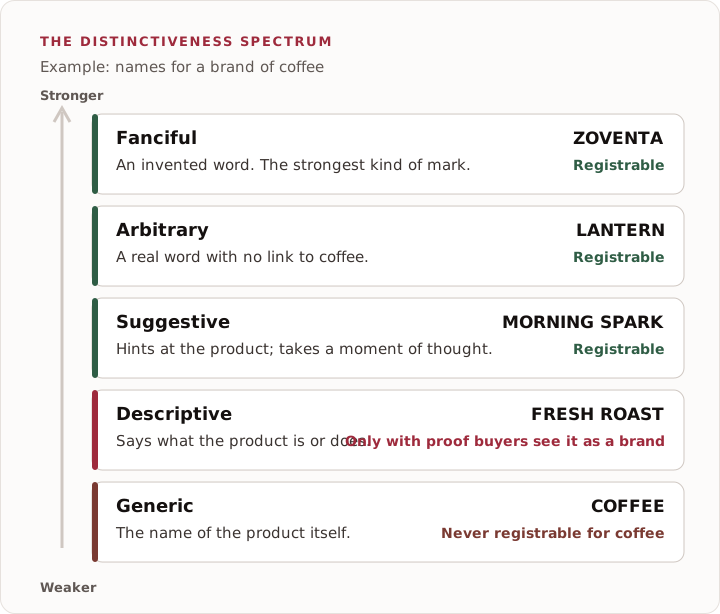
The less a name describes the product, the stronger it is as a mark. Generic names never register; descriptive names register only with proof that buyers see them as a brand. The examples are names for a coffee brand.
Registrability is a stack of separate bars in Section 2 of the Lanham Act, 15 U.S.C. § 1052, and a name has to clear all of them. Two common grounds are Section 2(d), which blocks a mark likely to be confused with one already registered, and Section 2(e)(1), which blocks a mark that merely describes the goods. Section 2(e) also reaches geographic terms and surnames, and Section 2 carries other bars besides.
Beneath all of them sits the definition itself, in 15 U.S.C. §§ 1051, 1052 and 1127: a trademark identifies and distinguishes goods and indicates their source. A term that is simply the name for the thing is generic and cannot be a trademark for it, no matter how famous it gets.
What the Board has done
Three decisions in this library, rewritten in plain English from the Board’s opinion.
HEALTHPLANS.COM was held generic for health insurance lead generation, because buyers read it as the name of a site where you shop for plans. The Board overturned the genericness finding for the applicant’s advertising-management software, where the term does not name the service — though the mark still did not reach the Principal Register in either class, because the applicant never argued that point on appeal.
SERIAL was refused for an investigative audio program. 172 million downloads and thousands of press stories did not save a plain-text word that names a kind of episodic content.
SHARPIN was refused for knife blocks with built-in sharpeners, because it is how you say “sharpen” — and respelling it during prosecution could not give the plain word a second meaning.
The USPTO’s refusal of HEALTHPLANS.COM for health insurance lead-generation and advertising services (Class 35) was upheld because the Board found that consumers would…
Read the plain summary →In re Katch, LLC · 2019No later change on its docketThe USPTO’s refusal to register the plain word mark SERIAL for Serial Podcast’s ongoing investigative audio program was upheld in full — the Board found SERIAL is simply the…
Read the plain summary →In re Serial Podcast, LLC · 2018No later change on its docketRefusal affirmedThe Board found SHARPIN for knife blocks with built-in automatic sharpeners merely descriptive because it is the phonetic equivalent of ‘sharpen’ and immediately describes…
Read the plain summary →In re Calphalon Corp. · 2017No later change on its docketGo deeper
Most names that are not blocked by someone else run into descriptiveness. The guide covers that ground and what the corpus shows about how it is decided.
What to do next
Search before you spend. Look for close names on related goods, not just identical names, and look at what is actually being sold rather than at the registration text alone. If you find something close, that is a reason to talk to a lawyer before you file, not a reason to file and hope.
A clean search on a distinctive name is a filing many owners make themselves. A close result is where a lawyer’s read is worth paying for.
If your search turned up a name close to yours, Valet Law, PLLC can review the results and tell you which ones need a closer look.
Attorney review is provided by Valet Law, PLLC, a law firm separate from Trademark Valet, LLC. Keep confidential facts out of public tools. Your first message to Valet Law should identify the parties and the general issue only. Wait until Valet Law confirms it can discuss the matter before sending confidential details.
Who checked this
Reviewed and approved by Brandon Leavitt on 2026-10-02.
General information about how trademark law works. It is not legal advice about your situation, and reading it does not make anyone your lawyer.