OFFICE ACTION
You received an Office Action
An Office Action is the examining attorney’s position, not the end of your application. Most pre-registration Office Actions give you three months to respond, with a one-time three-month extension available for a fee. Section 66(a) Madrid applications generally get six months with no extension, and some other actions run to different periods. Your Office Action states the deadline that applies to you. Start by finding your refusal below.
Have the letter? Office Action Review turns it into a report of each refusal and requirement, where the letter states it, and the response date.
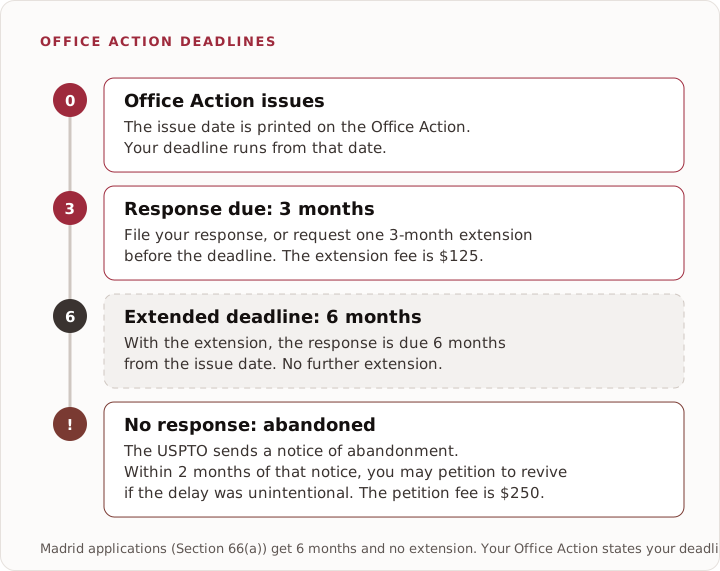
For most Section 1 and Section 44 applications, you have three months from the issue date to respond, with one three-month extension for a fee. Other actions can have different deadlines; follow the one stated in your Office Action. If no response is filed, the application is abandoned; a petition to revive is generally due within two months of the notice of abandonment.
Step 1 — Which refusal did you get?
It is printed at the top of the letter. You may have more than one.
Likelihood of confusion · Section 2(d)
Step 2 — What it means
The examining attorney found a registered mark they think is too close to yours, on goods they think are related.
Start with the examining attorney’s evidence. It shows why the USPTO considers the marks similar, why it considers the goods or services related, and what the refusal is actually built on.
Read the full page on likelihood of confusion →
Step 3 — What the Board has done with it
In the Section 2(d) decisions coded in this library, similarity of the marks and relatedness of the goods or services are the factors most often identified as driving the result.
Merely descriptive · Section 2(e)(1)
Step 2 — What it means
The examining attorney found that your name tells buyers what the product is, what it does, or what it is made of. The USPTO will not register a name like that on the Principal Register, because competitors need the same words to describe their own goods.
The refusal does not say the name is bad, and it does not decide whether you may use it. It is not necessarily the end of the application either. Depending on your filing basis and whether you have started using the mark, other paths may be open.
What merely descriptive means →
Step 3 — What to look at first
Start with the examining attorney’s evidence. It is usually dictionary entries, competitor websites and your own marketing copy. Ask what that evidence shows about how buyers read the words when they see them on your goods or services.
Specimen refused · Rule 2.56
Step 2 — What it means
The examining attorney found that the example you filed does not show your mark in real use. A specimen is a real-world example of the mark, the way buyers actually see it.
For products, that means the mark on the product, its label or tag, its packaging, or a point-of-sale display such as a web page where the product can be ordered. For services, it means the mark in advertising or selling the services. A mockup or digitally edited image is refused, however good it looks.
Step 3 — What to look at first
Read the reason the Office Action gives. It says what was wrong with the specimen you filed. Then check what counts as a proper specimen for your kind of goods or services.
Disclaimer required · Section 6
Step 2 — What it means
This is a requirement, not a refusal. The examining attorney is asking you to disclaim a descriptive word in a longer mark. A disclaimer says you do not claim that word by itself. You keep your claim to the mark as a whole.
A requirement is not a judgment that your mark is weak. But an unmet requirement can still sink the application.
Step 3 — What to look at first
Look for the wording the examining attorney wrote out for you. If the Office Action gives a standard disclaimer, you can often accept it directly in the response form. Answer it by the deadline, along with everything else in the letter.
Something else
Step 2 — What it means
The Office Action names the ground, usually by statute section, near the top. Most refusals fall into a few groups: your mark is too close to a registered one, it describes what you sell, it does not work as a brand, it is primarily a surname, or your specimen does not show real use.
Many Office Actions also list requirements. Those are fixes to the application, not objections to the mark.
Step 3 — What to look at first
Sort each item in the letter into one pile or the other: refusal or requirement. The response has to answer every one of them.
Why was my trademark refused? →Will people see my name as a brand at all? →
Step 4 — Decide how to handle it
Handle it yourself
Read the examining attorney’s evidence, read the page on your refusal, and file through TEAS. Some requirements are straightforward to correct yourself. Substantive refusals may need evidence and legal argument. If you are domiciled outside the United States, you cannot respond yourself; the USPTO requires a U.S.-licensed attorney.
Have an attorney review it
An attorney reviews the refusal and tells you what it turns on, what evidence would move it, and whether it is worth fighting. Provided by Valet Law, PLLC.
Keep the specifics of your situation out of public tools. Your first message to Valet Law should identify the parties and the general issue only. Wait until Valet Law confirms it can discuss the matter before sending confidential details.