Answer
What counts as an acceptable specimen?
Lawyers call this: specimen of use · 37 C.F.R. § 2.56 · TMEP § 904
Short answer
A specimen is a real-world example of your mark in use, the way buyers actually see it. For products, that means the mark on the product, its label or tag, its packaging, or a point-of-sale display such as a web page where the product can be ordered. For services, it means the mark in advertising or selling the services. A mockup or digitally edited image is refused, however good it looks.
What changes the answer
- Whether you sell goods or services
- Goods need the mark on or right next to the product at the point of sale. Advertising alone is not enough for goods. For services, advertising that shows the mark with the services is enough.
- Whether a web page lets people buy
- A product page counts as a display for goods only if it shows the product, shows the mark with it, and gives a way to order. A page that only advertises the product does not. Include the URL and the date you accessed or printed the page.
- For clothing: where the mark appears
- A brand on a neck label, a hangtag, or small over the pocket usually reads as a brand. The same words printed large across the front of a shirt may read as decoration, which draws a failure-to-function refusal. See What a failure-to-function refusal is A hangtag does not help a phrase buyers would read only as a message.
- For software: downloadable or online
- Downloadable software can use a screenshot of the program showing the mark, or a download page or app-store listing that shows the mark and a way to download or buy. Hosted or non-downloadable software is commonly identified as a service, so advertising that shows the mark used for the service can serve as a specimen.
The rule
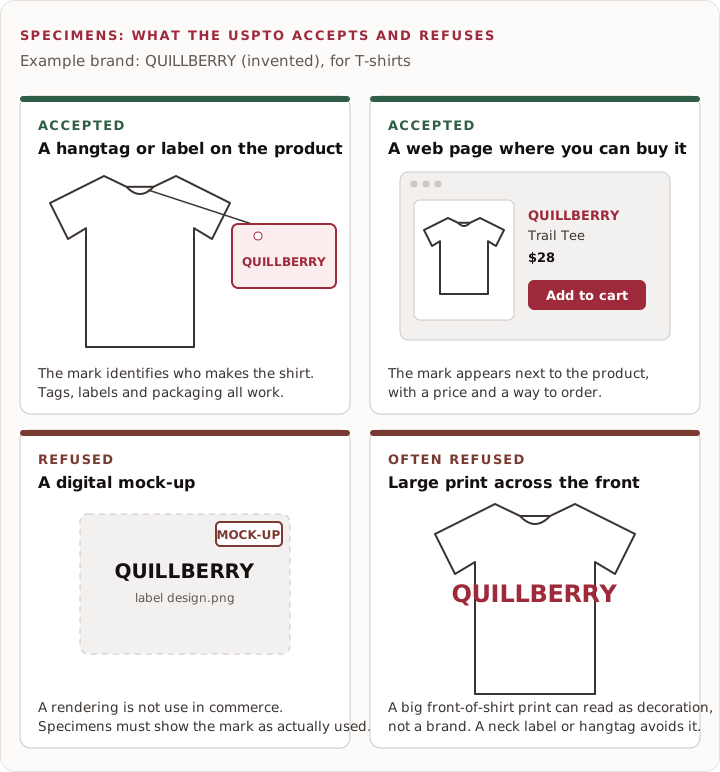
Accepted: the mark on a tag or label, or on a web page where the product can be bought. Refused: a digital mock-up. Often refused: a large print across the front of a shirt. QUILLBERRY is an invented example.
Each class needs one specimen showing the mark as actually used in commerce. 37 C.F.R. § 2.56(a) (2026).
For goods, the specimen must show the mark on the goods, their containers or packaging, labels or tags attached to them, or a display associated with the goods. A display must be of a point-of-sale nature. 37 C.F.R. § 2.56(b)(1) (2026); U.S. Pat. & Trademark Off., Trademark Manual of Examining Procedure §§ 904.03(a), (c), (g) (May 2026) [hereinafter TMEP]. A web page qualifies as a display when it shows the goods, shows the mark in association with them, and gives a means of ordering them. TMEP § 904.03(i). For downloadable software, a web page must let the buyer download or buy the software; a page that simply advertises it is not acceptable. TMEP § 904.03(e).
For services, the specimen must show the mark used in selling or advertising the services, with a direct association between the mark and the services. 37 C.F.R. § 2.56(b)(2) (2026); TMEP § 1301.04(f).
A photo, scan, or web page printout of the real thing is fine. An artist’s rendering, a printer’s proof, a computer illustration, or a similar mockup is not. 37 C.F.R. § 2.56(c) (2026). The same goes for an image of the goods or the advertising that was digitally created or altered to add the mark. TMEP § 904.04(a). Signs the USPTO looks for include a mark that seems to float over the product, pixels around the mark, and a web page with no URL or browser bar.
Decorative use is a separate problem. Matter that buyers would see only as ornament does not function as a mark. TMEP §§ 1202.03, 1202.03(a). A technically proper hangtag does not overcome that refusal when buyers would still read the words as a message. TMEP § 1202.04(d).
What to do next
Take a clear photo of the real product with the mark on it, or capture a web page where the product can be ordered, with the URL and date showing. For services, capture your website, an ad, or a brochure that names the service next to the mark. Check that the mark on the specimen matches the mark in the application.
Choosing and submitting a specimen is usually something you can do yourself. The facts are yours, and the test is concrete. If the USPTO has already refused the specimen, the fix is usually a substitute specimen with a sworn statement that it was in use by the right date: the filing date for a use-based application, or the Statement of Use deadline for an intent-to-use application. 37 C.F.R. § 2.59 (2026). A refusal that says the mark is merely ornamental or does not function as a mark is a different question, and it is worth a lawyer’s read before you answer it.
Attorney review is provided by Valet Law, PLLC, a law firm separate from Trademark Valet, LLC. Keep confidential facts out of public tools. Your first message to Valet Law should identify the parties and the general issue only. Wait until Valet Law confirms it can discuss the matter before sending confidential details.
Who checked this
Reviewed and approved by Brandon Leavitt on 2026-10-02.
General information about how trademark law works. It is not legal advice about your situation, and reading it does not make anyone your lawyer.