Answer
How do I trademark a business name?
Lawyers call this: trademark application · 15 U.S.C. § 1051
Short answer
You file an application with the USPTO through Trademark Center, its online filing system, and the USPTO examines it. The base fee is $350 for each class of goods or services. If no one opposes and the examining attorney approves it, the mark registers.
Most of the work happens before you file. Pick a name that works as a brand, search for conflicts, and describe exactly what you sell. Those three choices decide most applications.
Registering your business name with your state is a different thing. Forming an LLC or filing an assumed name does not give you trademark rights, and a trademark does not form a business.
What changes the answer
- How distinctive the name is
- A made-up or unexpected name registers most easily. A name that describes what you sell draws a refusal, and getting past it usually takes proof that buyers already see the name as your brand.
- Whether you are already selling under it
- If you are, you file on a use basis and show the mark as it is used. If you are not yet, you can file on an intent-to-use basis and prove use later, for extra fees.
- How you describe your goods and services
- The description sets what the registration covers. Choosing entries from the USPTO’s ID Manual avoids surcharges; writing your own adds $200 per class.
- Whether you are protecting the words, the logo or both
- A standard-character application protects the words in any style. A logo application protects the design as drawn. Each is its own application and its own fee.
- Where you are based
- An applicant domiciled outside the United States must be represented by a U.S.-licensed attorney. 37 C.F.R. § 2.11(a) (2026).
The rule
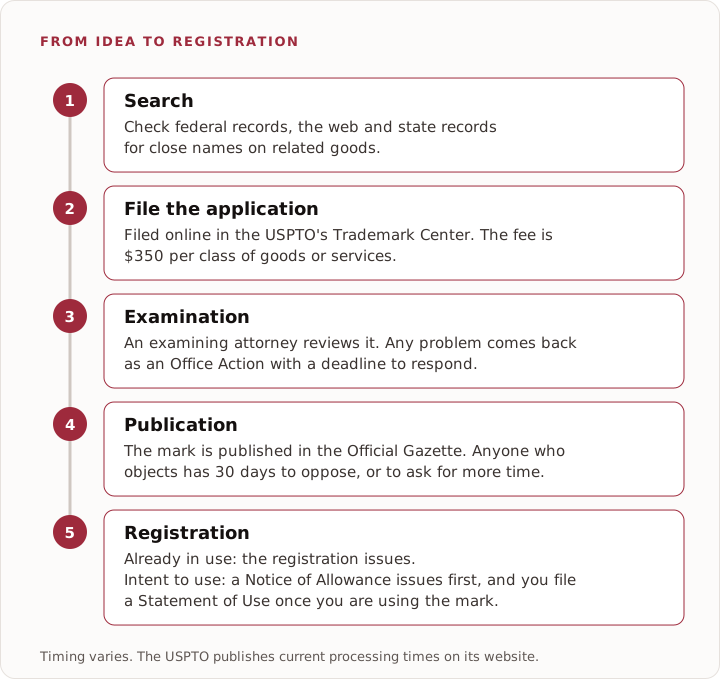
The path of a U.S. application: search, file, examination, publication, registration. An intent-to-use application adds a Statement of Use before it registers.
The application process is set by 15 U.S.C. § 1051 and the USPTO’s rules in 37 C.F.R. Part 2. The steps run in this order.
- File. You name the owner, show the mark, list the goods and services by class, and choose a basis. A use-based application under § 1051(a) needs a specimen showing the mark in use. An intent-to-use application under § 1051(b) needs a sworn statement of a bona fide intent to use it.
- Examination. An examining attorney checks the mark against the bars in 15 U.S.C. § 1052, including likelihood of confusion and descriptiveness. Any problem comes back as an office action. You generally have three months to respond, with one three-month extension for a fee. 37 C.F.R. § 2.62 (2026).
- Publication. An approved mark is published in the Official Gazette. Anyone who believes they would be damaged has 30 days to oppose or to ask for more time. 15 U.S.C. § 1063(a).
- Registration or allowance. A use-based mark then registers. An intent-to-use mark receives a notice of allowance. You then have six months to file a statement of use, with extensions in six-month steps up to 36 months from the notice. 15 U.S.C. § 1051(d); 37 C.F.R. §§ 2.88, 2.89 (2026).
The current fees, per class, are: $350 base application; a $100 surcharge if the application lacks required information; $200 for a free-form description instead of ID Manual entries, plus $200 for each further 1,000 characters; $150 for a statement of use; and $125 for each extension request. 37 C.F.R. § 2.6(a) (2026).
Registration is not the end. The owner files a declaration of continued use between the fifth and sixth years and renews every ten years. 15 U.S.C. §§ 1058, 1059.
What to do next
Search the name first and read the results against what you sell. Then look up your goods and services in the ID Manual and note the classes. File through Trademark Center with a USPTO.gov account.
A distinctive name, a clean search and goods that fit standard ID Manual entries make a filing many owners handle themselves. A close search result, a name that edges toward describing the product, or an office action once it arrives is where a lawyer earns the fee, because the way the application is framed at the start limits what can be argued later.
Trademark Valet provides information and research, not filing. If you want the application prepared and prosecuted, Valet Law, PLLC can review the name and the goods and handle the filing.
Attorney review is provided by Valet Law, PLLC, a law firm separate from Trademark Valet, LLC. Keep confidential facts out of public tools. Your first message to Valet Law should identify the parties and the general issue only. Wait until Valet Law confirms it can discuss the matter before sending confidential details.
Who checked this
Reviewed and approved by Brandon Leavitt on 2026-10-02.
General information about how trademark law works. It is not legal advice about your situation, and reading it does not make anyone your lawyer.