Answer
What does “merely descriptive” mean?
Lawyers call this: mere descriptiveness · Section 2(e)(1)
Short answer
Your name tells buyers what the product is, what it does, or what it is made of, so the USPTO will not register it on the Principal Register. The examining attorney is not saying the name is bad or that you cannot use it. They are saying it works as a description rather than as a brand, and that competitors need the same words to describe their own goods.
A descriptiveness refusal does not itself decide whether you may use the name — whether someone else’s rights block you is a separate question. And it is not necessarily the end of the application: depending on your filing basis and whether you have started using the mark, two further paths may be available.
What changes the answer
- What you said your goods are
- Descriptiveness is judged against the goods in your application, not against the word by itself. The same word can be descriptive for one product and arbitrary for another.
- Whether the buyer has to think
- If the meaning lands immediately, it is descriptive. If reaching it takes imagination, thought or perception, the term may be suggestive rather than descriptive, and suggestive terms are not refused as merely descriptive on that ground.
- What your own website says
- Examining attorneys quote applicants’ marketing copy back at them, and it is often the strongest evidence in the file. You wrote it.
- Whether combining words made something new
- If the parts stay descriptive when combined, the whole is descriptive too. The result changes when the combination creates a new or incongruous meaning.
- How long buyers have seen it as your brand
- Years of use, real sales and recognition can prove the name has become distinctive. That is a separate showing with its own evidence.
The rule
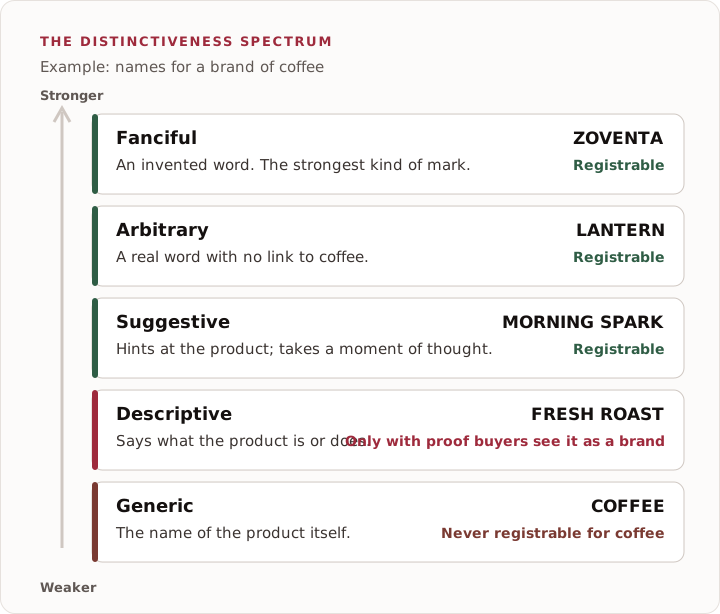
The less a name describes the product, the stronger it is as a mark. Generic names never register; descriptive names register only with proof that buyers see them as a brand. The examples are names for a coffee brand.
Section 2(e)(1) of the Lanham Act, 15 U.S.C. § 1052(e)(1), bars registration on the Principal Register of a mark that is merely descriptive of the goods or services — unless the mark has become distinctive of the goods under Section 2(f).
A mark is merely descriptive if it immediately conveys knowledge of a quality, feature, function, or characteristic of the goods or services, judged in relation to these goods and this buyer rather than in the abstract. See In re Bayer AG, 488 F.3d 960, 963 (Fed. Cir. 2007). A suggestive term, by contrast, requires imagination, thought or perception to reach a conclusion about the goods. See In re Abcor Dev. Corp., 588 F.2d 811, 813-14 (C.C.P.A. 1978).
Combining descriptive terms usually does not solve the problem: if the parts remain descriptive together, so is the whole, unless the combination creates a new or incongruous meaning. See In re Oppedahl & Larson LLP, 373 F.3d 1171, 1174-75 (Fed. Cir. 2004); U.S. Pat. & Trademark Off., Trademark Manual of Examining Procedure § 1209.03(d) (May 2026) [hereinafter TMEP]. Respelling does not help where buyers hear the same word. See In re Calphalon Corp., 122 U.S.P.Q.2d (BNA) 1153, 1164 (T.T.A.B. 2017).
If the wording is merely descriptive but still capable of functioning as a mark, two paths may become available: acquired distinctiveness under Section 2(f), 15 U.S.C. § 1052(f), and the Supplemental Register, 15 U.S.C. § 1091. Which is available depends in part on your filing basis and whether use has begun.
The Supplemental Register route carries a cost on an intent-to-use application. It cannot be taken until use has started and an acceptable allegation of use has been filed, and when the amendment is made the effective filing date becomes the date of that allegation of use — so the application is searched for conflicts again as of the later date, and marks filed in between can now be cited. See TMEP § 1102.03.
What the Board has done
Three decisions in this library, rewritten in plain English from the Board’s opinion.
SHARPIN was refused for knife blocks with built-in sharpeners because it is how you say “sharpen,” and respelling it mid-application could not give the plain word a second meaning.
NURSECON was refused for events because NURSE names the audience and CON is a known short form of convention, and the combination added nothing new.
HOUSEBOAT BLOB was refused for inflatable water-launch pads because each word kept its ordinary meaning in combination.
The Board found SHARPIN for knife blocks with built-in automatic sharpeners merely descriptive because it is the phonetic equivalent of ‘sharpen’ and immediately describes…
Read the plain summary →In re Calphalon Corp. · 2017No later change on its docketThe Board affirmed the refusal to register NURSECON for arranging and conducting special events for social entertainment purposes, finding the mark merely descriptive because…
Read the plain summary →In re Nursecon, LLC · 2024No later change on its docketRefusal affirmed on both groundsThe Board found HOUSEBOAT BLOB for inflatable water-launch float pads merely descriptive (each word keeps its ordinary meaning in combination) and separately too similar to…
Read the plain summary →In re Fat Boys Water Sports LLC · 2016No later change on its docketGo deeper
The guide walks the whole doctrine, including the two routes out and what the corpus shows about how these refusals are decided.
What to do next
Read the examining attorney’s evidence before you read the refusal. The dictionary entries and competitor pages are the case against you, and the answer is usually in what that evidence does not show — a different product, a different meaning, or nobody using the phrase the way the examiner says everyone does.
If you have used the name for years, or the Supplemental Register would serve your purpose, some of this is straightforward to handle yourself. Arguing that the name is suggestive rather than descriptive is legal argument, and usually worth an attorney’s read.
If you have this refusal, Valet Law, PLLC can review the examining attorney’s evidence and tell you which path is open.
Attorney review is provided by Valet Law, PLLC, a law firm separate from Trademark Valet, LLC. Keep confidential facts out of public tools. Your first message to Valet Law should identify the parties and the general issue only. Wait until Valet Law confirms it can discuss the matter before sending confidential details.
Who checked this
Reviewed and approved by Brandon Leavitt on 2026-10-02.
General information about how trademark law works. It is not legal advice about your situation, and reading it does not make anyone your lawyer.