Research library · Guide
Can a name be too common to protect at all?
Lawyers call this: genericness · Sections 1, 2, 3, 14 and 23
Short answer
Yes. If buyers understand a word as the name of the kind of product, rather than the name of one seller’s product, it is generic. A generic term cannot be registered on either USPTO register, and no amount of sales or advertising changes that.
Genericness depends on the product. APPLE is generic for apples and a strong mark for computers. The question is always what the word means to buyers of these goods or services.
Why it matters
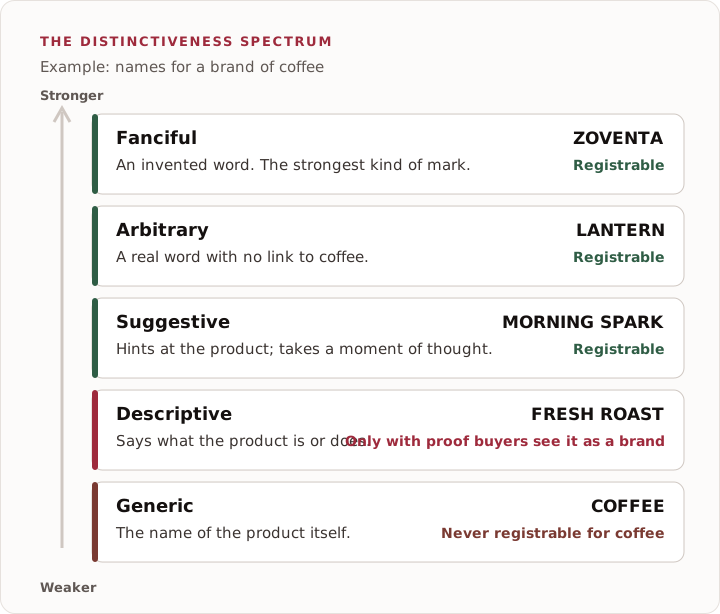
The less a name describes the product, the stronger it is as a mark. Generic names never register; descriptive names register only with proof that buyers see them as a brand. The examples are names for a coffee brand.
A descriptive name has a way out. It can register once buyers come to see it as a brand, or it can go on the Supplemental Register in the meantime. A generic name has no way out. Competitors need the word to say what they sell, so the law keeps it free for everyone.
That makes genericness the one distinctiveness problem that money and time cannot fix. It is worth ruling out before you print anything.
The risk also runs the other way, over time. A name that starts as a brand can become the ordinary word for the product if the public starts using it that way. The law calls this genericide. Aspirin, escalator and thermos are the familiar examples. A registration for a mark that has become generic can be cancelled at any time, even after it has become incontestable.
The governing law
A trademark, by definition, identifies one source and distinguishes it from others. A generic term cannot do that, so it fails the registration provisions for trademarks and service marks in Sections 1, 2 and 3 of the Lanham Act, 15 U.S.C. §§ 1051–1053. Section 23 keeps generic terms off the Supplemental Register as well. 15 U.S.C. § 1091(c). Section 14 lets anyone with standing petition to cancel a registration “at any time if the registered mark becomes the generic name for the goods or services.” 15 U.S.C. § 1064(3).
The test. The Federal Circuit asks two questions. First, what is the genus — the category — of goods or services at issue? Second, does the relevant public understand the term primarily to refer to that genus? H. Marvin Ginn Corp. v. Int’l Ass’n of Fire Chiefs, Inc., 782 F.2d 987, 990 (Fed. Cir. 1986). The genus usually comes from the identification of goods or services in the application or registration. The relevant public is the actual or likely buyers of those goods.
The evidence. Buyer understanding is shown through dictionaries, how competitors and the media use the term, how the applicant itself uses it, and consumer surveys. The USPTO bears the burden of proving a term generic, by a preponderance of the evidence. The TMEP’s older reference to “clear evidence” does not mean a heightened clear-and-convincing standard. In re PT Medisafe Techs., 134 F.4th 1368, 1374 n.4 (Fed. Cir. 2025); see U.S. Pat. & Trademark Off., Trademark Manual of Examining Procedure § 1209.01(c)(i) (May 2026) [hereinafter TMEP].
Generic.com terms. In USPTO v. Booking.com B.V., 591 U.S. 549 (2020), the Supreme Court rejected a rule that a generic word plus “.com” is automatically generic. Whether BOOKING.COM is generic turns on whether consumers perceive it as the name of a class of services. The lower courts found they did not, so the term could register. The decision did not make every generic.com term registrable. It made the genericness question depend on evidence of consumer perception. If the term is not generic but remains merely or highly descriptive, registration on the Principal Register ordinarily requires proof of acquired distinctiveness. See TMEP § 1215.05.
Combinations. Joining two generic words does not always produce a generic whole. The Board asks whether the combination, taken as a whole, still names the genus to buyers.
What this library shows about genericness
This library is not yet sorted by legal ground, so it cannot yet say how often genericness decides a case, or which way.
In the decision library you will find each decision’s marks, goods or services, posture, and the result in plain words, with a note on whether the decision is precedential and what happened to it afterward. Read the reasoning in the decisions themselves. This page states the doctrine from the statute, the TMEP and the cases above, not from counts.
Important decisions
What to do next
If you are choosing a name, test it the way the Board would. Write down the category your goods or services fall in. Then search the name with that category in mind: dictionaries, competitors’ websites, marketplace listings and trade publications. If other sellers use your word to name the product, buyers probably read it as the product. Pick a different name. That check you can do yourself.
If you already own a mark that people use as a noun or verb, use it the way brands are used: as an adjective followed by the generic word (“XYZ tissues,” not “an XYZ”). Correct misuse in your own materials and your partners’ materials first. That is also something you can manage without a lawyer.
A genericness refusal, or a petition to cancel on genericness, is different. The outcome turns on how the genus is defined and on the evidence of buyer understanding, and both are argued. That is where an attorney earns the fee.
If you have a genericness refusal or a cancellation claim, Valet Law, PLLC can review the evidence and tell you whether the record can support registration.
Attorney review is provided by Valet Law, PLLC, a law firm separate from Trademark Valet, LLC. Keep confidential facts out of public tools. Your first message to Valet Law should identify the parties and the general issue only. Wait until Valet Law confirms it can discuss the matter before sending confidential details.
Update log
| 2026-09-19 | Page created. Corpus counts computed from 178 analyzed decisions. |
Who checked this
Reviewed and approved by Brandon Leavitt on 2026-10-02.
General information about how trademark law works. It is not legal advice about your situation, and reading it does not make anyone your lawyer.