Research library · Guide
Can a descriptive name become protectable?
Lawyers call this: acquired distinctiveness · Section 2(f)
Short answer
Yes, if buyers come to see it as your brand. A name that describes the product starts out unregistrable on the Principal Register. Once the public links the name to one source, it can register under Section 2(f). The law calls this acquired distinctiveness, or secondary meaning.
Five years of substantially exclusive and continuous use can be enough, but only for names that are not highly descriptive. The more a name describes, the more evidence it takes. A generic name never gets there.
Why it matters
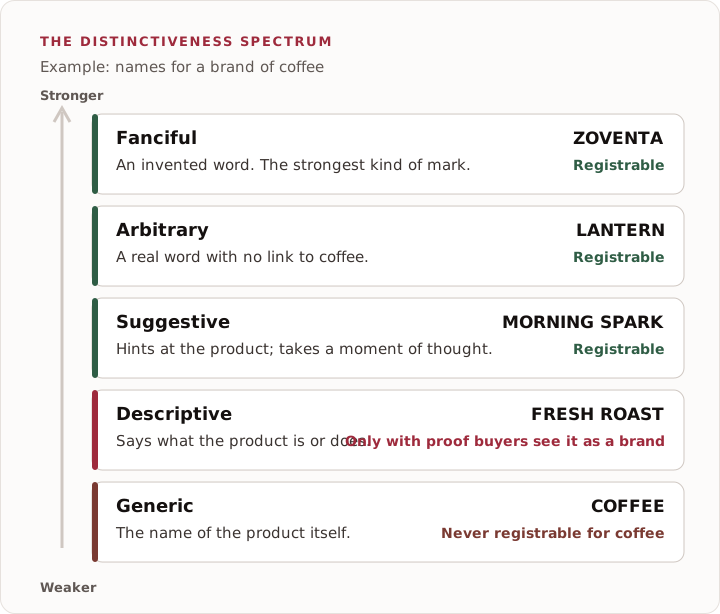
The less a name describes the product, the stronger it is as a mark. Generic names never register; descriptive names register only with proof that buyers see them as a brand. The examples are names for a coffee brand.
Descriptive names are tempting because they tell buyers what you sell with no marketing needed. The cost is that the USPTO will refuse them under Section 2(e)(1) until you can prove buyers see them as a brand. Until then, others can use the same words to describe their own goods.
Acquired distinctiveness also matters outside the USPTO. An unregistered descriptive name is protected in court only from the point it acquired distinctiveness. For priority, what counts is when buyers began to see the name as a brand, not when you started using it. See Otto Roth & Co. v. Universal Foods Corp., 640 F.2d 1317 (C.C.P.A. 1981).
The governing law
Section 2(f) lets the USPTO register a mark that has “become distinctive of the applicant’s goods in commerce.” 15 U.S.C. § 1052(f). It can overcome certain refusals based on descriptiveness, primarily geographic descriptiveness, or surname significance when the required distinctiveness is proved. Id. § 1052(e)(1), (e)(2), (e)(4), (f). It does not make generic or functional matter registrable. Functional matter is expressly excluded. Id. § 1052(e)(5), (f). A generic term is not a mark at all, so there is no distinctiveness to acquire; see the genericness guide. It also cannot save a primarily geographically deceptively misdescriptive mark under Section 2(e)(3), unless that mark became distinctive before December 8, 1993. Id. § 1052(f).
Three ways to claim it. The rules allow a claim based on (1) ownership of a prior Principal Register registration of the same mark for sufficiently similar goods, (2) five years of use, or (3) other evidence. 37 C.F.R. § 2.41(a) (2026).
The five-year claim. The statute says the USPTO “may accept as prima facie evidence” of distinctiveness proof of “substantially exclusive and continuous use” as a mark “for the five years before the date on which the claim of distinctiveness is made.” 15 U.S.C. § 1052(f). Two words in that sentence do real work. “May” means the USPTO has discretion. “Substantially exclusive” means significant use of the same words by others undercuts the claim. For a highly descriptive term, a five-year declaration alone is usually not enough. See U.S. Pat. & Trademark Off., Trademark Manual of Examining Procedure § 1212.05(a) (May 2026) [hereinafter TMEP].
Actual evidence. When five years is not enough, or not yet available, the applicant proves buyer perception directly. The usual evidence is:
- length, amount and exclusivity of use;
- sales figures and advertising spending, with examples of the advertising;
- advertising that directs attention to the name as a brand, often called “look-for” advertising;
- unsolicited media coverage that uses the name as your brand;
- declarations from customers or people in the trade;
- consumer surveys.
See 37 C.F.R. § 2.41(a)(3) (2026); TMEP § 1212.06. Sales and advertising figures alone show that a product is popular. They do not show that buyers see the name as a brand, and the Board weighs them that way.
The Supplemental Register. A descriptive name that has not yet acquired distinctiveness can go on the Supplemental Register if it is capable of distinguishing the goods and is in lawful use in commerce. 15 U.S.C. § 1091. A Supplemental registration lets you use the ® symbol, and the USPTO can cite it against later confusingly similar applications. It does not carry the legal presumptions of a Principal Register registration, and it does not give nationwide priority from the filing date. See 15 U.S.C. §§ 1057(c), 1094; TMEP § 815. An application filed on an intent-to-use basis cannot move to the Supplemental Register until use is shown. You can later apply for the Principal Register under Section 2(f) once your evidence is ready.
What this library shows about acquired distinctiveness
This library is not yet sorted by legal ground, so it cannot yet say how often a Section 2(f) claim succeeds, or what evidence carried it.
In the decision library you will find each decision’s marks, goods or services, posture, and the result in plain words, with a note on whether the decision is precedential and what happened to it afterward. Read the reasoning in the decisions themselves. This page states the doctrine from the statute, the rules, the TMEP and the case above, not from counts.
Important decisions
What to do next
If you are still choosing a name, the cheapest fix is a name that does not describe the product. A descriptive name means years of evidence-building before the Principal Register is open to you.
If you already use a descriptive name, start keeping the evidence now. Save dated examples of advertising, sales and ad-spend totals by year, press coverage, and messages from customers who refer to you by name. Use the name consistently, as a brand, and deal with copycats early, because others’ use erodes the “substantially exclusive” part of the claim. You can do all of this yourself.
A refusal in hand is a different decision. You will have to choose between arguing the name is not descriptive, claiming acquired distinctiveness on the evidence you have, and amending to the Supplemental Register. Unless it is made in the alternative, a 2(f) claim is treated as a concession that the name is not inherently distinctive. See TMEP § 1212.02(b)–(c). That choice is where an attorney earns the fee.
If you have a descriptiveness refusal, Valet Law, PLLC can review your evidence of use and tell you which path the record supports.
Attorney review is provided by Valet Law, PLLC, a law firm separate from Trademark Valet, LLC. Keep confidential facts out of public tools. Your first message to Valet Law should identify the parties and the general issue only. Wait until Valet Law confirms it can discuss the matter before sending confidential details.
Update log
| 2026-09-19 | Page created. Corpus counts computed from 178 analyzed decisions. |
Who checked this
Reviewed and approved by Brandon Leavitt on 2026-10-02.
General information about how trademark law works. It is not legal advice about your situation, and reading it does not make anyone your lawyer.