Answer
How do I respond to an Office Action?
Lawyers call this: Office Action response · 37 C.F.R. § 2.62
Short answer
You file a written response online, through the USPTO’s TEAS Response to Examining Attorney Office Action form, before the deadline printed in the Office Action. For most applications that deadline is three months from the issue date, and you can buy one three-month extension for $125. The response has to answer every refusal and every requirement. If you miss the deadline, the application is abandoned.
What changes the answer
- Whether the Office Action is final
- The standard response form is for nonfinal actions. After a final action you file a request for reconsideration, a notice of appeal, or both. See What can I do after a final refusal?
- What the examining attorney raised
- A requirement the examining attorney wrote out for you, such as new wording for your goods, can often be accepted as written. A substantive refusal, such as a 2(d) conflict, needs argument and evidence. See Why was my trademark refused?
- Where you are based
- A business or person domiciled outside the United States must use a U.S.-licensed attorney. You cannot file the response yourself.
- How your application was filed
- An application that came through the Madrid Protocol, under Section 66(a), gets six months to respond and no extension.
The rule
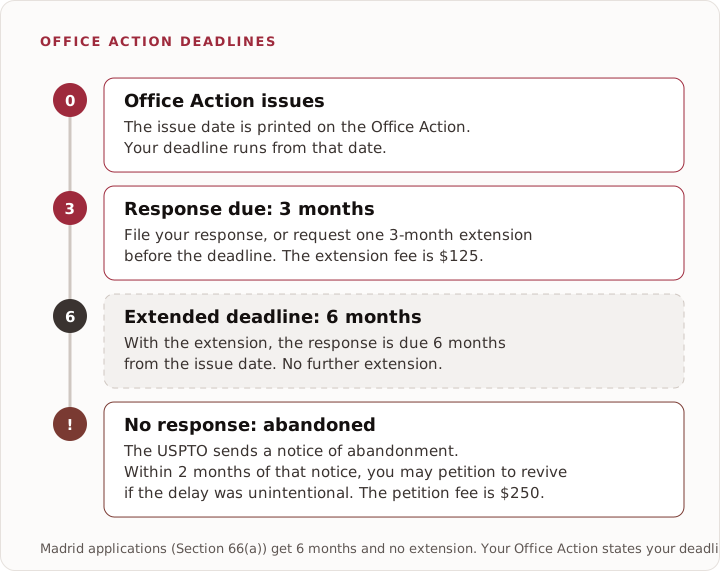
You have three months from the issue date to respond, with one three-month extension for a fee. If no response is filed, the application is abandoned; a petition to revive is due within two months of the notice of abandonment.
Each Office Action states its own deadline. For an application under Section 1 or Section 44, the response period is three months from the issue date. You may extend it by three months, to a maximum of six months from the issue date, by filing a request and paying the fee on or before the original deadline. 37 C.F.R. § 2.62(a) (2026). The current fee for an electronically filed extension request is $125. 37 C.F.R. § 2.6(a)(28)(ii) (2026). Madrid applications under Section 66(a) get six months. 37 C.F.R. § 2.62(a)(1)(ii) (2026).
Responses and extension requests must be filed electronically, through the USPTO’s TEAS forms; a response sent by plain email or fax gets no filing date. 37 C.F.R. § 2.62(c) (2026). The USPTO also accepts extension requests through Trademark Center. The response must be signed by the applicant, someone with authority to bind the applicant, or a qualified attorney. 37 C.F.R. § 2.62(b) (2026). An applicant domiciled outside the United States must be represented by a U.S.-licensed attorney. 37 C.F.R. § 2.11(a) (2026).
A late or incomplete response abandons the application. 37 C.F.R. § 2.65(a) (2026). If the delay was unintentional, you can petition to revive. The petition is due within two months of the notice of abandonment. It must include the response, a statement that the delay was unintentional, the $250 petition fee, and, for a three-month Office Action, the $125 extension fee. 37 C.F.R. §§ 2.66(a)–(b), 2.6(a)(15) (2026). If you never received the notice of abandonment, a different two-month window runs from when you learn of it, capped at six months after the USPTO record shows the application abandoned. 37 C.F.R. § 2.66(a)(2) (2026).
What to do next
Put the deadline on your calendar the day the Office Action arrives. If you need more time, file the extension request before the deadline, not after it. An extension cannot be requested late.
Read the whole action. List each refusal and requirement, and answer each one in the response. Leaving one out is an incomplete response.
For small fixes, the examining attorney may invite a call or email. Accepting a suggested amendment that way can settle a requirement without a formal filing.
About templates. A template cannot know which registration the examining attorney cited, what evidence was attached, or which ground the refusal rests on. A response to a substantive refusal is argument built on that record, and evidence usually has to be in the record before any appeal. That is legal work, so Trademark Valet does not provide response templates.
Simple requirements are different. If the Office Action asks for a disclaimer or suggests new wording for your goods and services, you can often accept it directly in the response form.
If your Office Action includes a substantive refusal, Brandon Leavitt at Valet Law, PLLC can review the examining attorney’s evidence and prepare the response.
Attorney review is provided by Valet Law, PLLC, a law firm separate from Trademark Valet, LLC. Keep confidential facts out of public tools. Your first message to Valet Law should identify the parties and the general issue only. Wait until Valet Law confirms it can discuss the matter before sending confidential details.
Who checked this
Reviewed and approved by Brandon Leavitt on 2026-10-02.
General information about how trademark law works. It is not legal advice about your situation, and reading it does not make anyone your lawyer.